
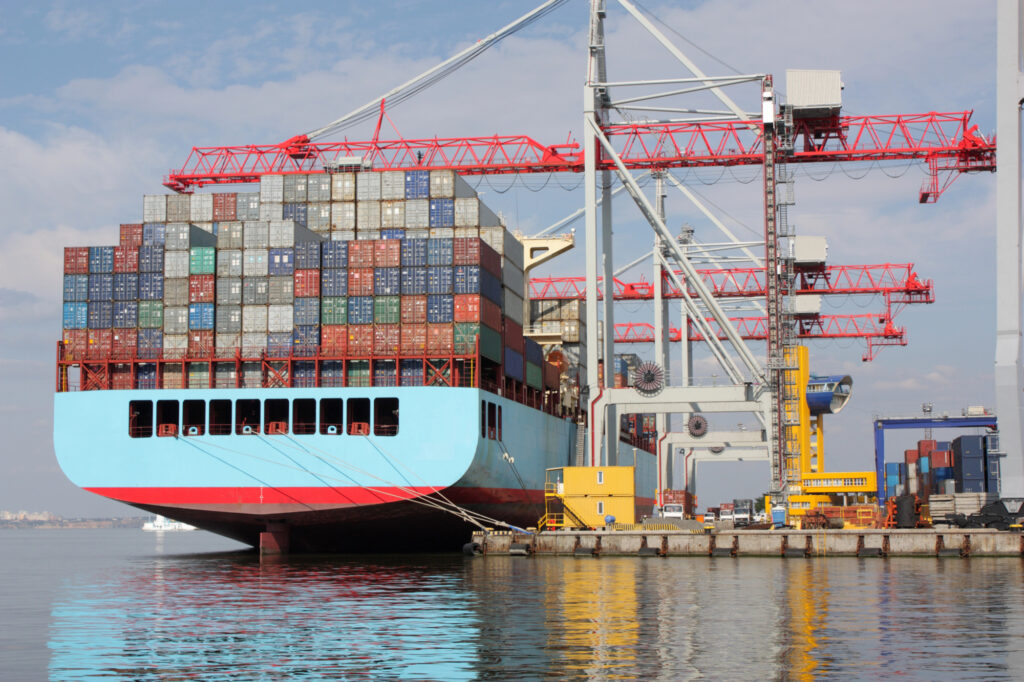
AI bottlenecks in software development work a lot like congestion at a busy shipping port. Imagine a major port suddenly installing cranes capable of unloading containers twice as fast. At first, the upgrade looks like a major productivity win. But if customs, warehouses, truck gates, and rail connections all continue to operate at the same speed, the port has not eliminated congestion. It has simply moved it somewhere else.
That same dynamic came up repeatedly in a recent interview with Axian Solutions Architect Justin Hart. Generative AI can help engineering teams write, revise, and ship code faster than before, but the rest of the delivery process does not automatically accelerate with it.
Requirements still need to be defined. Code still needs to be reviewed. Software still needs to be tested and business decisions still need to be made.
As AI increases development throughput, organizations are discovering that the real constraint may no longer be writing the code.
AI Accelerates Development but Not the Whole System
AI coding tools can increase engineering throughput quickly but software delivery is a chain of dependent activities. If one link suddenly moves faster, the constraint often shifts somewhere else.
Hart has already seen this happen with engineering teams using tools such as Claude.
“QA can’t keep up fast enough with the amount of enhancements that our engineering teams are throwing out there,” he said. In other cases, the bottleneck moves even farther upstream: “We can’t feed requirements in fast enough because the engineering teams are just moving through the backlog faster than we anticipated.”
This is the software equivalent of unloading ships faster than the rest of the port can process the cargo. More code reaches review sooner. Test queues grow. Product teams have less time to clarify requirements and make decisions. Infrastructure and deployment processes may suddenly be asked to handle more frequent changes.
The result can look paradoxical: individual developers become more productive while the overall delivery system becomes more congested. AI does not remove the need for coordination, review, testing, and decision-making. It actually tends to increase the pressure on each of them.
Where AI Bottlenecks in Software Development Appear
As development speeds up, congestion begins to surface at the handoff points between teams. Hart identifies several recurring pressure points.
Requirements and Business Decisions
Product teams and business stakeholders may find that engineering throughput is beginning to outpace the cadence at which work has traditionally been defined, prioritized, and clarified. Hart described a recent Axian client whose AI adoption exposed exactly this problem: developers were moving through the backlog faster than requirements could be supplied. “If you lag on those decisions, the downstream impact is your engineering teams are potentially sitting idle, or they’re going in a different direction than you originally anticipated.”
Code Review
Higher development throughput also puts more pressure on code review. AI may help produce code faster but reviewers still need enough time to understand changes, catch defects, and verify that the implementation matches the intent. The bottleneck simply moves from writing code to approving it. A recent analysis of more than 500 R&D organizations found that teams with high levels of AI-generated code waited 105% longer for an initial code review than teams with lower AI usage.
QA and Testing
Testing teams can use AI too, but their workload still grows when engineering throughput increases. If development accelerates faster than QA capacity, releases begin stacking up at another checkpoint.
Systems and Architecture
Increased activity can also expose weaknesses that were easier to ignore at lower volume, such as:
- Unstable integrations
- Outdated APIs
- Fragile infrastructure
- Deferred maintenance
In port terms, faster cranes do not remove customs inspections, warehouses, or truck gates. They send more cargo toward them. AI bottlenecks in software development emerge for the same reason: improving one stage of the system increases pressure on every stage downstream.
Adapt the System, Not Just the Coding Step
If AI shifts the bottleneck rather than eliminating it, the answer is not simply to accelerate every overloaded stage with another AI tool. Organizations need to redesign their workflows around the new pace of development.
This might mean tightening requirements before work reaches engineering, automating more routine testing, changing how pull requests are structured, or giving reviewers better ways to prioritize high-risk changes. In any case, the need has become measurable. A recent study of more than 8.1 million pull requests found that AI-assisted pull requests were 2.6 times larger at the 75th percentile than unassisted ones. AI-related pull requests also spent substantially longer waiting for review, even though they moved through review faster once someone picked them up.
For Hart, that requires organizations to reconsider processes built for a different development cadence:
“We can’t continue doing things as we did and still throw AI in the mix. We now need to start adjusting.”
The shipping-port analogy applies here too. A port facing congestion would not solve the problem by installing faster cranes while leaving customs, warehouses, and ground transportation unchanged. It would redesign the flow of cargo through the entire facility. Software organizations need to undergo the same redesign: identify where work now accumulates, then change the process around the new constraint rather than optimizing coding speed in isolation.
Measure the Whole Flow, Not the Crane Speed
Redesign starts with measuring the right things. If organizations focus only on coding speed, they may miss slower reviews, growing test queues, higher defect rates, or other signs that the constraint has simply moved elsewhere.
A 2025 industry report found that 90% of technology professionals were already using AI at work and more than 80% believed it had increased their productivity. Yet the same research found that greater AI adoption was also associated with increased software delivery instability. It seems individual productivity and system performance are not necessarily the same thing.
According to Hart:
“You need to evaluate: how is AI impacting my teams? Is it making me better at certain tasks? Is it creating more problems?”
The useful question, then, is not simply whether AI helps developers produce code faster. Organizations need to measure what happens across the entire delivery system, identify where the new constraints emerge, and adapt accordingly.
Keep AI Acceleration from Becoming a Bottleneck
AI can increase development speed without improving delivery. Axian helps teams identify where constraints are shifting and adapt the delivery system around them.
If AI is changing the pace of your development process, talk with Axian about how the rest of the delivery system can keep up.